

The legacy of swordfish fishing in Calabria
In the waters where Calabria meets Sicily, an ancient maritime ritual lives on. In the Strait of Messina, fishermen have engaged for centuries in a fair, respectful duel with the king of the Tyrrhenian Sea: the swordfish. More than a simple catch, swordfish fishing is a living tradition steeped in myth and heritage.
The anatomy of the feluca: the boat employed by fishermen
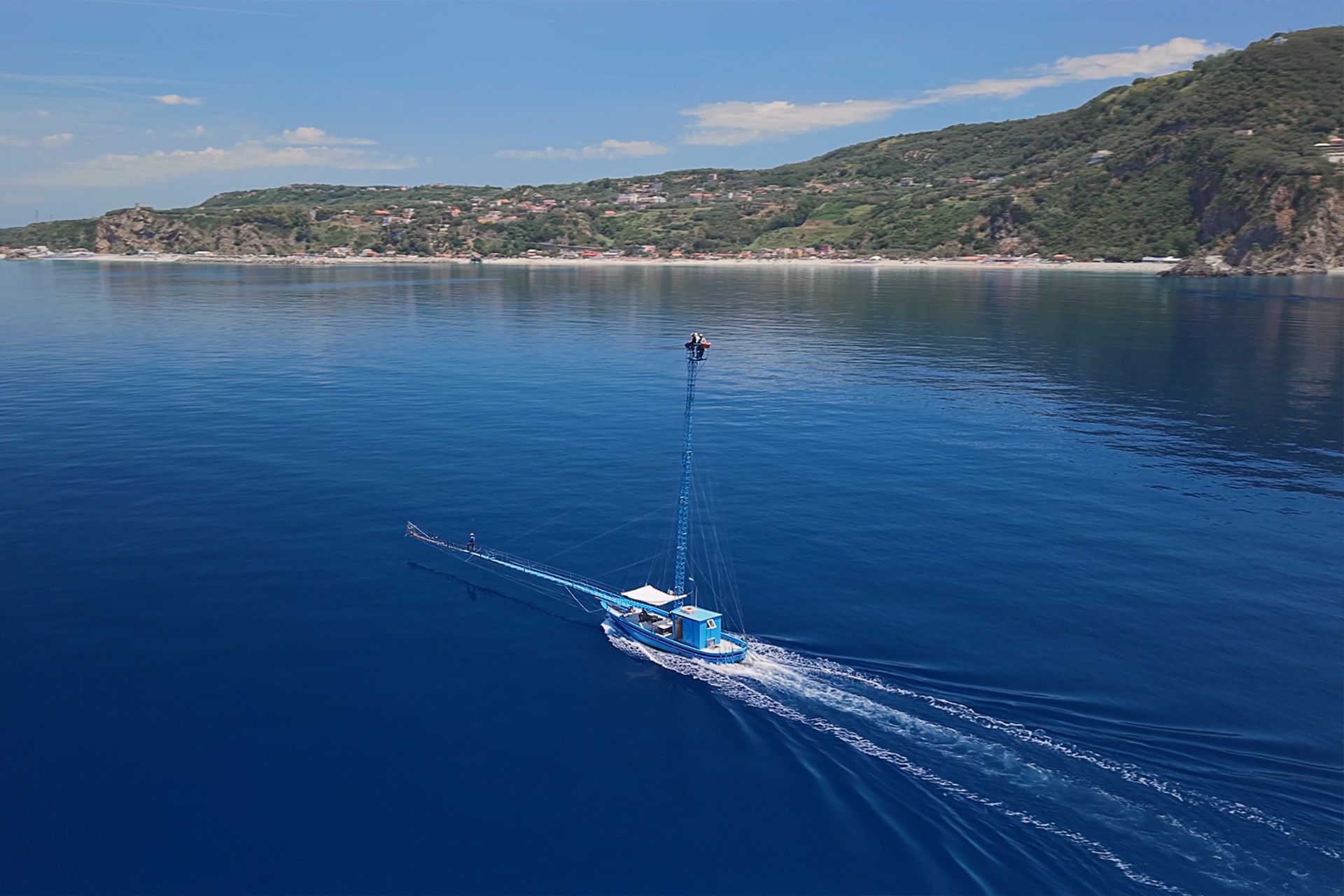
Where fishermen once relied on sheer muscle power aboard traditional wooden rowing boats (luntri), today they navigate the waters aboard feluche. These vessels are true masterpieces of maritime craftsmanship, instantly recognizable by two dramatic features. Rising 20 to 25 meters above the hull is a towering steel lookout mast. Stationed at the top, motionless under the sun, sits the spotter—trained to catch every subtle ripple or silver flash beneath the surface. Extending from the bow is a narrow metallic catwalk projecting 25 to 30 meters over the open sea. Suspended just above the waves at its furthest tip stands the harpooner (lanziere), ready to strike the moment the boat aligns with its prey.
Orchestrating this seamless operation is the captain, maneuvering the vessel from an elevated wheelhouse to maintain an uninterrupted view of the chase.
Constellations and devotion: the myth of the hunt
Swordfish hunting—known historically as spatàre—takes place during the summer months, from May to August. This is when swordfish swim near the surface through the Strait to spawn, traveling along the coastline between Scilla and Bagnara Calabra.
The hunt follows ancient codes and sacred rituals. One such tradition is the Palla Fenicia: a wooden sphere painted blue or red and adorned with the stars of Ursa Major, resting at the bow. Originating from ancient Phoenician seafaring, this astronomical charm is said to guide the route and bring good fortune.
Another surviving ritual is the Cardàta da’ crùci. Once the fish is brought aboard, fishermen pay homage to their catch by scoring four small cross marks into the animal’s right cheek with a fingernail. It is a gesture of deep reverence—a quiet thank-you for the sacrifice of a noble opponent.
Until fairly recently, the catch was accompanied by chants sung in Grecanico, a rare dialect blending ancient Greek and local speech. Legend held that the swordfish—a majestic and sensitive creature—could only be soothed by the cadences of that ancient tongue.
A culinary treasure protected by Slow Food
Swordfish from the Strait features remarkably firm, lean meat, forged by the intense sea currents that require the fish to swim continuously against powerful tides.
In Calabrian cuisine, it is celebrated through legendary recipes: from classic pesce spada alla ghiotta (simmered with tomatoes, capers, and olives) to simple grilled swordfish finished with local salmoriglio (a bright whisk of olive oil, fresh lemon, garlic, and wild oregano).
In May 2024, this extraordinary heritage was officially designated a Slow Food Presidium. This prestigious recognition honors more than just a culinary delicacy; it safeguards an entire cultural ecosystem. Feluca fishing stands as the complete opposite of industrial fishing—it is highly selective, taking just one fish at a time, and serves as a model of how humanity can live in harmony with the sea.